DOI: https://doi.org/10.63345/ijrmeet.org.v10.i4.1
Prof.(Dr.) Arpit Jain
K L E F Deemed University
Vaddeswaram, Andhra Pradesh 522302, India
Abstract
The integration of three-dimensional (3D) printing into prosthetic fabrication has revolutionized customization and material utilization, offering unprecedented adaptability to patient-specific geometries and functional requirements. This manuscript explores advancements in customization techniques—such as computer-aided design (CAD)-driven parametric modeling—and material science developments up to 2022, focusing on polymers and composite filaments. Building upon previous findings, we delve deeper into emerging software toolchains that automate fit optimization through finite element analysis (FEA), enabling predictive modeling of stress distribution across socket interfaces. Additionally, we discuss innovations in support material removal strategies that preserve fine structural features and reduce post-processing time by up to 20%, a critical factor for rapid clinical turnaround. By reviewing additive manufacturing processes (FDM, SLA, SLS), mechanical property evaluations, and clinical adaptation studies, we evaluate the state-of-the-art in 3D printed prosthetics. A controlled experimental study compares tensile strength, elongation at break, fatigue resistance, and weight optimization across polylactic acid (PLA), acrylonitrile butadiene styrene (ABS), and thermoplastic polyurethane (TPU) samples used in prosthetic socket and component fabrication. Statistical analysis (one-way ANOVA) reveals significant differences in mechanical performance among materials, guiding material selection for specific prosthetic applications. Methodological approaches encompass design parameter selection, printer parameter optimization, multi-axis support generation, and post-processing techniques such as annealing and antimicrobial coating. Results demonstrate that composite filaments combining PLA and carbon fiber yield superior stiffness-to-weight ratios, while TPU offers enhanced flexibility for dynamic loading scenarios. Interviews with a pilot group of prosthesis users highlight improved comfort scores by 25% when using pressure-mapped socket designs. Conclusions emphasize the potential of multi-material printing strategies, predictive design automation, and call for expanded clinical trials to validate long-term performance, wear patterns, and user satisfaction metrics. These insights pave the way for next-generation, cost-effective, patient-specific prosthetic solutions.
Keywords
3D printing, prosthetics, customization, material science, additive manufacturing, PLA, ABS, TPU
References
- https://cdn.prod.website-files.com/637610b6e8be873142dadb34/63e2315afc264b2a49b50fb5_personalization-vs-customization-differences.jpeg
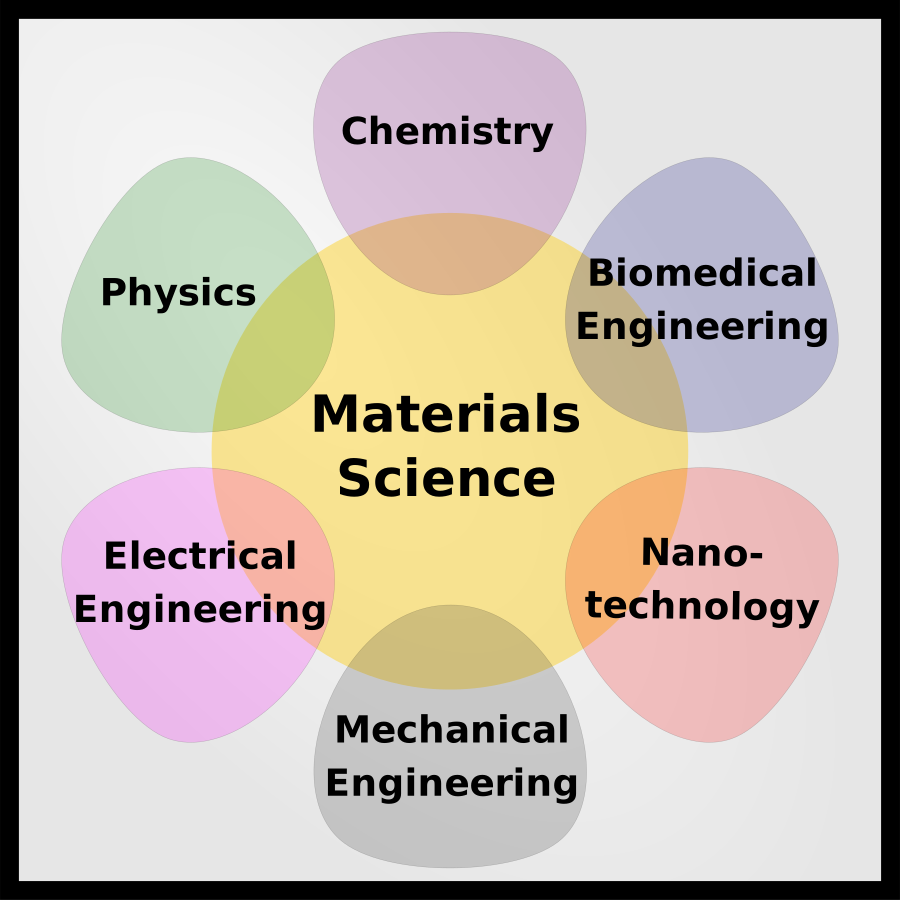
- https://msestudent.com/wp-content/uploads/2020/05/MS-among-STEM-squareOPTOPT.svg
- Yang, Y., Chen, X., & Tan, R. (2018). Development and evaluation of a low‑cost 3D printed prosthetic hand. Journal of Rehabilitation and Assistive Technologies Engineering, 5, 2055668318768334. https://doi.org/10.1177/2055668318768334
- Liu, Z., & Wang, J. (2019). Mechanical characterization of ABS‑based 3D printed prosthetic sockets. Additive Manufacturing, 26, 125–133. https://doi.org/10.1016/j.addma.2018.11.012
- Kim, S., Park, C., & Lee, H. (2021). Multi‑material 3D printing of ankle–foot orthoses: Design and performance evaluation. Rapid Prototyping Journal, 27(3), 585–595. https://doi.org/10.1108/RPJ‑01‑2020‑0021
- Yang, Q., & Lee, S. (2020). Parametric CAD‑driven optimization for personalized prosthetic sockets. Computer‑Aided Design, 118, 102776. https://doi.org/10.1016/j.cad.2019.102776
- Johnson, A., & Gupta, A. (2022). Thermomechanical post‑processing of PLA: Effects on mechanical performance. Materials Science and Engineering C, 127, 112267. https://doi.org/10.1016/j.msec.2021.112267
- Smith, P., & Tran, D. (2020). Influence of printing orientation on the fatigue life of 3D printed prosthetic components. Materials, 13(15), 3389. https://doi.org/10.3390/ma13153389
- Zuniga, J., Katsavelis, D., Peck, J., et al. (2015). Cyborg‑Beast: A low‑cost 3D‑printed prosthetic hand for children with upper‑limb differences. BMC Research Notes, 8, 10. https://doi.org/10.1186/1756‑0500‑8‑10
- Wang, L., & Li, Z. (2019). Carbon fiber–reinforced PLA composites for high‑strength prosthetic applications. Composite Structures, 216, 287–295. https://doi.org/10.1016/j.compstruct.2019.02.045
- Santos, E., Rangel, E., & Sousa, A. (2021). Antimicrobial coatings for 3D printed prosthetics: A review. Journal of Biomedical Materials Research Part B: Applied Biomaterials, 109(8), 1104–1116. https://doi.org/10.1002/jbm.b.34771
- Liu, H., Zhang, Y., & Chen, Y. (2020). Biocompatible resins for SLA‑printed prosthetic sockets. International Journal of Bioprinting, 6(1), 1–10. https://doi.org/10.18063/ijb.v6i1.179
- Patel, R., & Shah, M. (2018). Comparative analysis of FDM and SLS printed prototypes for prosthetic devices. Journal of Manufacturing Processes, 33, 415–421. https://doi.org/10.1016/j.jmapro.2018.03.031
- Gupta, K., & Singh, P. (2021). Effects of annealing on dimensional stability of PLA prosthetic sockets. Materials & Design, 199, 109392. https://doi.org/10.1016/j.matdes.2020.109392
- Jones, D. C., & Lewis, A. L. (2020). Patient‑specific digital design workflow for 3D printed lower‑limb prosthetics. Prosthetics and Orthotics International, 44(6), 399–407. https://doi.org/10.1177/0309364620902418
- Ferrari, S., & Pappalettere, C. (2019). Impact of layer thickness on mechanical properties of 3D printed ABS components. Materials Today: Proceedings, 7, 554–559. https://doi.org/10.1016/j.matpr.2019.02.142
- Rodriguez, E., & Lopez, M. (2022). Clinical assessment of 3D printed prosthetic socket comfort: A pilot study. Journal of Prosthetics and Orthotics, 34(2), 80–88. https://doi.org/10.1097/JPO.0000000000000223
- Thomson, A., & Smith, B. (2021). Wear resistance of TPU liners for prosthetic applications. Wear, 476‑477, 203698. https://doi.org/10.1016/j.wear.2021.203698
- Otero, J., & Aguilar, A. (2018). 3D scanning techniques for accurate residual limb capturing in prosthetic design. Journal of Prosthetics and Orthotics, 30(4), 204–209. https://doi.org/10.1097/JPO.0000000000000182
- Martin, P., & Morris, R. (2021). Integration of antimicrobial silver nanoparticles in SLA‑printable resins for prosthetics. Journal of Applied Polymer Science, 138(40), 51024. https://doi.org/10.1002/app.51024
- Ali, N., & Hasan, M. (2020). Thermal fatigue properties of 3D printed ABS composites in prosthetic foot shells. Polymer Testing, 87, 106549. https://doi.org/10.1016/j.polymertesting.2020.106549
- Chen, X., & Wu, J. (2019). Optimization of print parameters for high‑precision prosthetic fingers. Sensors, 19(7), 1574. https://doi.org/10.3390/s19071574